Reformed Theology is for Everyone.

Reformed Theology is for Everyone.
2026 The Present Day
1647 Westminster Shorter Catechism The Westminster Shorter Catechism, written alongside the longer, was based upon the Heidelberg Catechism and Calvin's Geneva Catechism to instruct children and families on the Christian faith. It provides a concise summary of Reformed doctrine and is capable of being memorized at any age.
1647 Westminster Larger Catechism The Westminster Larger Catechism, written alongside the shorter, was designed to supplement and expand upon the contents of the Shorter. It presents a full and balanced summary of the Christian faith and is more suitable for those who have attained some level of spiritual maturity
1646 Westminster Confession of Faith Drawn up by the 1646 Westminster Assembly, the Westminster Confession is the most widely adopted reformed confession in the world. It is used for doctrinal standards of presbyterians, Dutch Reformed, and others.
1618 The Synod of Dort Dort was a council of nine reformed countries convened to repudiate the teachings of Jacob Arminius outlined in the Articles of Remonstrance
1610 The Five Articles of Remonstrance Written by 43 dutch reformed pastors after the death of Jacob Arminius in 1609, the articles of remonstrance articulated five points of concern with reformed theology.
1592 The Saxon Visitation Articles Commissioned by Frederick William against crypto-calvinism, the Saxon Visitation Aritcles describe four points where lutherans reject reformed doctrine.
1571 39 Articles of Religion Written after Henry VIII broke with the Roman church, the 39 articles created a via media between catholic and protestant doctrine, and would be the standard for the Church of England
1563 Heidelberg Catechism Commissioned by Frederick III to unite the faith of his territories, the Heidelberg catechism would quickly become the greatest of the reformed catechisms, and is one of the three forms of unity of the reformed churches in Europe.
1562 Second Helvetic Confession Originally written by Heinrich Bullinger as a private exercise, the Second Helvetic Confession was translated into German at the request of Frederick III. It came to be a popular confession among the Swiss reformed churches.
1561 Belgic Confession Written by Guido de Brès before his martyrdom, the Belgic confession is the primary confession of the Dutch reformed church, and also one of the Three Forms of Unity.
1560 The Scots Confession Written by John Knox, the Scots Confession was the foundational document in the Scottish reformation and presbyterianism
1537 The Smalcald Articles The Smaldald Articles were written by Martin Luther to summarize lutheran doctrine for the Schmalkaldic League. They were adopted into the book of concord in 1580
1530 The Augsburg Confession One of the most important reformation confessions, the Augsburg Confession was presented to Holy Roman Emperor Charles V after the Lutherans were summoned to explain their theological convictions
1523 Zwingli's 67 Articles Written by Ulrich Zwingli in 1523 as a defense of his protestant theology, these articles would begin the Swiss Reformation.
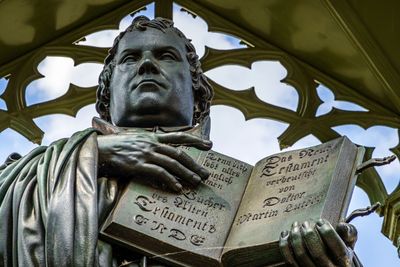
1517 Luther's Ninety-Five Theses Written by Martin Luther in 1517 to address the practice of selling indulgences, the ninety-five thesis presented a critique of the medieval church that kicked off the protestant reformation.
1517 The Protestant Reformation
1420 The Four Articles of Prague Written by the followers of John Hus after his execution, the articles outline four reforms wanted by the proto-protestant Bohemian reformers.
1180 The Waldensian Confession Written by Peter Waldo, this confession outlined the faith of the proto-protestant Waldensians, who would later join the reformed churches.
1054 The Great East-West Schism
529 The Second Council of Orange Convened to address semi-Pelagianism, the second council of Orange emphasized the necessity of grace and the inability of man to seek God without grace
451 The Council of Chalcedon Chalcedon sought to uphold the two natures of Christ without confusion or admixture against the monophysites, the error opposite of Nestorianism
449 The Epistle of Leo to Flavian Leo, the bishop of Rome, writes to Flavian, the bishop of Constantinople, in order to give an orthodox explanation of Christ's two natures. This letter was accepted by the Council of Chalcedon as orthodox Christology.
431 The Council of Ephesus Called in 431 to address the teachings of Nestorius, the Council of Ephesus reaffirmed unity of Christ's two natures, that Christ's person is fully God, and the propriety of calling Mary the mother of God.
430 The Second Epistle of Cyril to Nestorius Cyril again writes to Nestorius on behalf of a council convened at Alexandria, urging him to repent of his heresy and layout out right doctrine
429 The First Epistle of Cyril to Nestorius Cyril, the bishop of Alexandria, admonishes Nestorius for his seperation of the two natures of Christ, and refusing to say Mary is the mother of God.
420 The Second Letter of Jerome to Evangelus Jerome proves from the scriptures that presbyters are the same as bishops, and over deacons.
411 Augustine's Sermon on the Eucharist Augustine explains that the Eucharist is the body of Christ, that it is grasped by faith, and that it is composed of believers
381 The First Council of Constantinople Called by Emporer in 381 to reaffirm the Nicean faith, the first council of Constantinople expanded the Nicean creed's section on the Holy Spirit. This was a local eastern synod that was recognized as ecumenical at Chalcedon in 451.
330 Athanasius On Luke 10:22 and Matthew 11:27 Combatting the Arian heresy, Athansius writes on Luke 10:22 and Matthew 11:27 seeking to prove the eternal unity of the Father and the Son, and to refute the Arian interpretation of these passages.
325 The Council of Nicea Called by Emporer Constantine in 325 to address the Arian controversy, the Council of Nicea reaffirmed the divinity of Christ and defined what would become the Nicean Creed.
Creation
Our beliefs are based on the Bible and the teachings of Jesus Christ. We believe in the Trinity, salvation through faith in Jesus, and the importance of living a life of love and service. Click below to learn more about our beliefs.
We believe that church is more than just a Sunday service - it's about being a part of a community that supports and encourages one another. Click below to learn more about our events and opportunities to get involved.
Our staff is dedicated to serving our congregation and community. Click below to learn more about our pastors, ministry leaders, and support staff.
We would love to have you join us for a Sunday service or one of our events. Click below to plan your visit and learn more about what to expect when you come to Reformed Methodist Church.

George Whitefield, was an English Anglican priest and preacher who was one of the founders of Methodism and the evangelical movement. Born in Gloucester, he matriculated at Pembroke College, Oxford in 1732. Wikipedia
Born: December 16, 1714, Gloucester, United Kingdom
Died: September 30, 1770 (age 55 years), Newburyport, MA
Place of burial: Old South Presbyterian Church, Newburyport, MA
Spouse: Elizabeth James (m. 1741–1768)
Parents: Thomas Whitefield, Elizabeth Edwards -Wikipedia.

The Doctrines of Grace, often summarized by the acronym TULIP, are five theological pillars of (Reformed theology) that emphasize salvation as the absolute work of God's sovereign grace, rather than human effort. They include Total Depravity, Unconditional Election, Limited Atonement, Irresistible Grace, and Perseverance of the Saints, highlighting that God saves sinners. The Five Points of TULIP
These doctrines are designed to demonstrate that salvation is entirely by grace for God's glory alone.
Historic Reformed Theology is rooted in doctrines emphasizing divine sovereignty and human inability which were synthesized at the Synod of Dort, in a theological answer to Joseph Arminius and the Remonstrants who opposed to Historic Reformed Theology.
Historic Reformed Theology is supported by verses highlighting unconditional election, irresistible grace, and total depravity. Key, frequently cited passages include Ephesians 1:4-5, Romans 9:16, John 6:44, and Romans 8:29-30, which emphasize God's purposeful, sovereign role in salvation. Key Calvinist Biblical Proof Texts
Core Supporting Verses
These verses are used to argue that God is in complete control of salvation from beginning to end.
While faith and science may seem like two opposing concepts, many people believe that they can coexist. Science can explain the how, while faith can provide the why.
Religious practices vary widely, from prayer and meditation to fasting and pilgrimage. These practices can help people connect with their faith and deepen their spiritual experience.
Faith can provide a moral compass and guide people in making ethical decisions. Many religions have their own set of values and principles that help followers live a virtuous life.
Join us as we strive to spread love and hope to our community.
John Wesley (1703–1791) was an 18th-century Anglican clergyman, theologian, and evangelist who founded the Methodist movement. As a major leader in the18th-century Evangelical revival, he emphasized personal holiness, faith-based salvation, and social justice. His work, which included extensive open-air preaching, profoundly shaped British and American Protestantism. Key Facts About John Wesley:
His 1738 spiritual experience on Aldersgate Street, where he felt his heart "strangely warmed," is often cited as a pivotal turning point in his life and ministry.
The doctrine provides a foundation for optimism in evangelism. It means God is already at work in every person's life before the church even arrives to share the gospel. It also ensures that no one is without excuse, as every person has been given enough "light" to begin seeking God
In Wesleyan theology, prevenient grace (from the Latin praevenire, meaning "to come before") is the divine love and power that surrounds all humanity and precedes any human initiative toward God. John Wesley championed this concept as the essential "first step" in the journey of salvation, arguing that while humans are born in a state of total depravity due to original sin, God’s universal grace partially restores the capacity to respond to Him. Core Characteristics
Discover upcoming events and activities at Reformed Methodist Church, including youth groups, Bible studies, and community outreach programs.
Find out how you can get involved in our church community, from volunteering to joining a small group. We welcome everyone to come as they are and get connected.
Have a question or want to learn more about Reformed Methodist Church? Contact us today and we'll be happy to help you.
Support our church and our community outreach programs by making a donation today. Every little bit helps us make a difference.

Baptism is an important step of obedience and public declaration of faith.
We understand that life can be difficult and painful at times.
We believe that giving is an act of worship and a way to support the work of God's Kingdom.
We believe that God's presence is real and powerful, and that He desires to encounter us in a personal way.
Walking with God!
https://youtu.be/pt-Xu3JC1sg?si=-cM_PjaWHLHyOXFA
A Repentant Heart!
https://youtu.be/Mp61wr8pgYU?si=nF68ysGwfE60Ou4P
Marks of a True Conversion!
https://youtu.be/UQ6YCISfutU?si=sKhYNHcop4naRIkE
The Potter and The Clay!
https://youtu.be/XVuZ3qY4PFI?si=kgaV5DTVmH2lVVRE
We believe that everyone has something to offer and a role to play in the work of the church. We offer a variety of volunteer opportunities and ministry teams where you can use your gifts and talents to make a difference. Click below to learn more about our volunteer opportunities.

Our mission is to empower individuals and families to grow in their faith and become active members of our community. We strive to love God, love people, and make a difference in the world.
Join us for our weekly services, where we come together to worship, pray, and learn from God's word. Our services are open to everyone, and we welcome you to come as you are.
Explore our various ministries, including children's ministry, youth group, women's ministry, and more. We have something for everyone, and we believe that everyone has a place in our church family.
Stay connected with our church community by attending our upcoming events, such as potlucks, movie nights, and community service projects. We love to have fun and serve together!
Have a question or want to learn more about our church? Contact us today, and we'll be happy to assist you. You can also follow us on social media to stay up-to-date on our latest news and events.
John Wesley Bio:
https://youtu.be/gH6Hqu12sDk?si=eA-cGKeN9QWcfRJt
https://youtu.be/jN36jAZK5K4?si=67sqTtIV8KRzt4TU
https://youtu.be/XdlVv6sFiR8?si=QTTr6W1iCIrvBXuW
https://youtu.be/vslx8xKURhU?si=UsEuiyrU_KLrvp4G
https://youtu.be/UwjdD_JbOok?si=Y3VT14dT5Qchxldz
Learn about our mission, beliefs, and values at Theological History Church. Join us as we strive to spread love and hope to our community.
Join us for our weekly services, where we come together to worship, learn, and grow. Find out more about our service times and locations.
Discover upcoming events and activities at Theological History Church, including youth groups, Bible studies, and community outreach programs.
Find out how you can get involved in our church community, from volunteering to joining a small group. We welcome everyone to come as they are and get connected.
Have a question or want to learn more about Theological History Church? Contact us today and we'll be happy to help you.
Support our church and our community outreach programs by making a donation today. Every little bit helps us make a difference.
We welcome you to our Sunday service, where we come together to worship and hear a message from our pastor. Our service starts at 10:00am and lasts approximately 1.5 hours. We look forward to seeing you there!
We have a variety of ministries that you can get involved with, including children's ministry, youth ministry, and adult small groups. These ministries provide opportunities for fellowship, growth, and service. Click below to learn more about our ministries.
Our beliefs are based on the Bible and the teachings of Jesus Christ. We believe in the Trinity, salvation through faith in Jesus, and the importance of living a life of love and service. Click below to learn more about our beliefs.
We believe that church is more than just a Sunday service - it's about being a part of a community that supports and encourages one another. Click below to learn more about our events and opportunities to get involved.
Our staff is dedicated to serving our congregation and community. Click below to learn more about our pastors, ministry leaders, and support staff.
We would love to have you join us for a Sunday service or one of our events. Click below to plan your visit and learn more about what to expect when you come to Theological History Church.
Baptism is an important step of obedience and public declaration of faith. We offer baptism services several times a year, and would love to help you take this important step. Click below to learn more about baptism and how to sign up.
We understand that life can be difficult and painful at times. That's why we offer support groups and resources to help you find hope and healing in the midst of life's challenges. Click below to learn more about our support groups.
We believe that giving is an act of worship and a way to support the work of God's Kingdom. We offer a variety of ways to give, including online giving, text-to-give, and in-person giving. Click below to learn more about giving at Theological History Church.
We believe that God's presence is real and powerful, and that He desires to encounter us in a personal way. We offer opportunities to experience God's presence through prayer, worship, and other spiritual practices. Click below to learn more.
We believe that kids and teens are an important part of our church community. We offer age-specific ministries for kids and teens, where they can learn about God in a fun and engaging way. Click below to learn more about our kids and teens ministries.
We believe that everyone has something to offer and a role to play in the work of the church. We offer a variety of volunteer opportunities and ministry teams where you can use your gifts and talents to make a difference. Click below to learn more about our volunteer opportunities.
At Theological History Church, our mission is to empower individuals and families to grow in their faith and become active members of our community. We strive to love God, love people, and make a difference in the world.
Join us for our weekly services, where we come together to worship, pray, and learn from God's word. Our services are open to everyone, and we welcome you to come as you are.
Explore our various ministries, including children's ministry, youth group, women's ministry, and more. We have something for everyone, and we believe that everyone has a place in our church family.
Stay connected with our church community by attending our upcoming events, such as potlucks, movie nights, and community service projects. We love to have fun and serve together!
Have a question or want to learn more about our church? Contact us today, and we'll be happy to assist you. You can also follow us on social media to stay up-to-date on our latest news and events.
Support our church's mission and ministry by giving financially. Your donations help us make a difference in our community and beyond. Give today, and be a part of something meaningful.
At Theological History Church, we believe that everyone has a unique purpose and calling in life. We offer classes and resources to help you discover your purpose and take steps towards fulfilling it. Click below to learn more.
We believe that life is better when we do it together. That's why we offer a variety of small groups and events where you can connect with others and build meaningful relationships. Click below to learn more about our community.
We believe that spiritual growth is a lifelong journey. We offer classes, resources, and opportunities to help you grow in your faith and deepen your relationship with God. Click below to learn more about our spiritual growth opportunities.
We believe that serving others is an important part of living out our faith. We offer a variety of service opportunities both locally and globally, where you can make a difference in the lives of others. Click below to learn more about our service opportunities.
We believe that worship is a powerful way to connect with God and experience His presence. We offer dynamic worship services that incorporate music, prayer, and teaching. Click below to learn more about our worship services.
We would love to hear from you and help you get connected at Theological History Church. Click below to contact us and learn more about how you can get involved.